How to train your dog at home-III: Outdoor training
How to Train Your Dog at Home-III: Outdoor training
-
Dr JM Panda Dr Jatindra M Panda
Many times, it is necessary to take your dog outside for bowel or bladder evacuation, exercise, etc. Many times, when you are planning to visit somewhere with your family, you want to take your dog with you. When your dog steps out of its house or leaves its territory, it will come across outdoor environments such as stray animals like dogs and cattle, moving vehicles, people on the footpath, sounds of vehicles, etc. There is a natural tendency of the dog to react to such external stimuli. Many times, such reactions create an unpleasant situation for the passing by people. For example, fighting with a street dog, chasing vehicles running on the road running after stray cattle are undesirable activities. Your dog must behave decently when taken outside. It is the duty of the owner that your dog should not be a nuisance to others in the street.
In this article, we shall discuss in detail how to train your dog for outdoor activities so that you can control and command your dog. We have covered basic house training of your dog in the first part of the article, which includes basic manners training. In the second part of the training series, we have covered in-house obedience training. If you have not gone through those parts, please read them first at the link mentioned at the bottom of this article and then read this post. In this article, we will learn how to train your dog to learn good behaviour on the street in an outdoor environment.
Table of Contents
Crossing the road
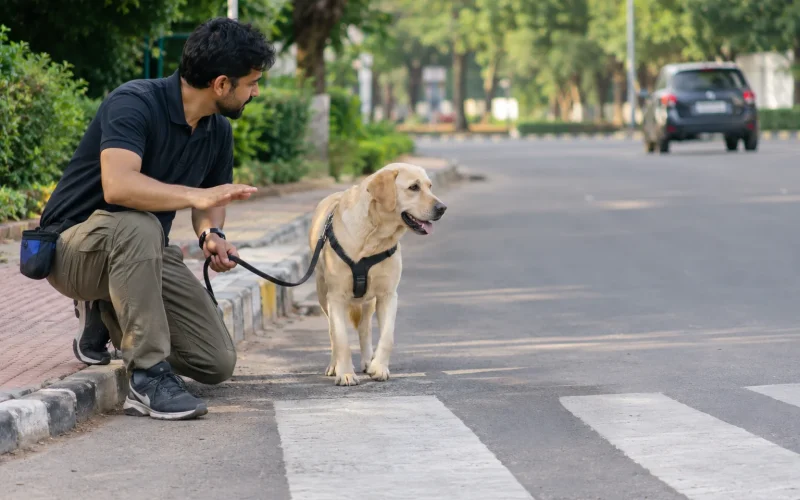
Your dog must know how and when to cross the road. To teach your dog regarding crossing the road is an important aspect of outdoor training. Follow the simple steps to teach this lesson.
- Whenever you take your dog out for a walk, put him on a long line.
- Stop him at every crossing of the road, and order him to cross the road only when it is clear of traffic.
- Give the command STOP aloud just before the dog steps onto the road, so that it is clearly impressed on his mind that the crossing of the road is to be done only after receiving a command from you. He will soon get into the habit of waiting for the command at every crossing, and will not cross unless he is ordered to do so.
Confrontation with street dogs
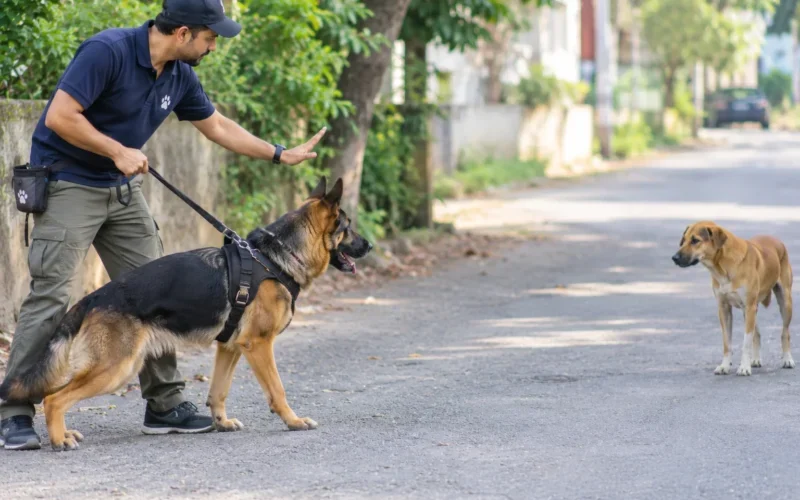
Your dog should know street behaviour, such as not to go to strange dogs and should always avoid a confrontation with strange dogs. Follow the simple steps to teach this lesson.
- When you go out with your dog, and there is a danger of him coming across strange dogs, it is always advisable to keep your dog on the long line for easy control.
- When he is tempted by another dog, call him back and, if necessary, jerk the line. Be careful to call your dog as he is about to go to the stranger, and not when he has actually reached him.
- Gradually train your dog not to go to an unknown dog, on your verbal command alone without jerking the line.
- If you find that the dogs are already standing face to face, do not call your dog back because, if you call your dog at this point and he starts to return to you, the stranger will take him as a coward and will immediately attack him. Call off your dog only when the two begin to wave their tails.
- If there is a start of a fight, you must not start to beat one dog as it will redouble the fury of the other. But try to separate the combatants by seizing their collars and dragging them apart. Be sure to allow the stranger to run away first.
- If the fight becomes an obstinate one, water thrown on the dogs’ heads is the easiest method to pacify them.
By this, slowly your dog will start ignoring other strange dogs and always try to avoid a confrontation.
Chasing the vehicle
How to Train Your Dog at Home-III: Outdoor training
Some dogs are fond of chasing moving vehicles, which may cause serious accidents, and in this way, such dogs can lose their life. It is important to train your dog not to chase any moving vehicle instead. Follow this simple step to teach this lesson
- Take your dog to a nearby field, putting a long line with a spiked collar around his neck.
- Tie the other end of the line to a fixed object like a pole. If not available, hold the other end firmly.
- Ask your assistant to drive the car. Let the dog chase the passing car. He will receive a nasty shock when the spikes pinch his throat on reaching the end of the line. Repeat this several times until your dog stops chasing moving vehicles.
Training for automobile
Your dog must know the dangers associated with automobiles. Many dogs do not leave the road when they see a vehicle approaching and lose their lives. To teach the lesson
- Ask an assistant to drive a car at a moderate speed towards the dog. If the dog persists in maintaining his dangerous position, the assistant should blow the sharp electric horn (specially fitted in the car).
- If the dog still does not run away, the driver should hit him gently with his bumper. By repeating this, you can correct such bad habits in dogs.
Travelling in a car
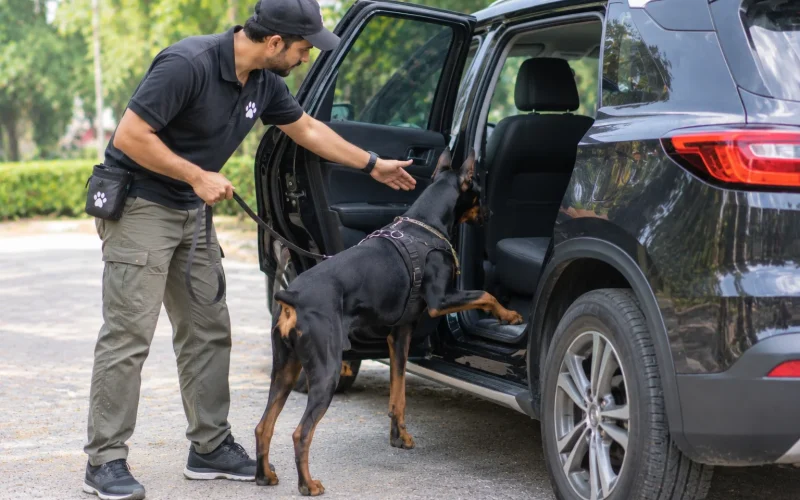
Most dogs love riding in a car and get very excited when they think a trip is imminent. While travelling in a car with your dog, some safety tips must be followed. Follow these simple tips for a hassle-free trip whenever you take your dog with you.
- Many dogs develop the habit of jumping into any car that has an open door. Never allow your dog to enter a car unless you ask him to do so.
- Never allow your dog to enter the car before you get in. Always get into the car first and allow the dog to follow you; if he hesitates, with the help of a short lead it will be possible to make him climb in. Then allow the dog to sit beside you, give him a reassuring pat and start moving.
- If he feels uncomfortable inside give him opportunity to look out of the windows, but never allow to peep outside with its head hanging out of the window, as this can cause serious problem of the eyes.
- Specify a space (floor or seat) you would like your dog to occupy in the car every time your dog rides in the car. If he is not taught to stay in a particular spot and in a particular position, he is likely to cause inconvenience to other passengers by constantly shifting his position.
- Never take your dog every time you go by car. If you do not want to take him in the car, command him to go back and stay at home. If you do not accustom him to stay behind in this way, he will create a terrible disturbance at home whenever you want him to stay behind.
Car sickness
Like human being dog also develops motion sickness. Few dogs develop nausea, vomition other digestive disturbances after few hours of travel. To deal with such situations, follow these tips.
- Make your dog accustomed to vehicle motion by making regular short trips. By this, the dog will be familiarised to the motion of the car and overcome car sickness.
- Withhold all food and water from your dog for several hours before setting off on a journey.
- If the problem persists, give sedative tablets after consulting your veterinarian.
Not to Pick Up Food Lying on Ground
It is a natural tendency to smell things on the roadside or other places when he is out of the house. Many accidents occur when dogs pick up spoiled meat/food from the garbage or poisonous and rotten food placed anywhere by an enemy or thief. It is essential that such habits be curbed from the beginning. Follow the simple tips to train your dog not to pick up things lying on the ground.
Training tips
- Place some food baits on the ground and allow your dog to move around the baits when he is on the lead. Any attempt to take baits should be countered with a firm ‘No’ instruction and by giving a sharp jerk on the lead. Gradually build upon the distance that you are away from your dog or in a hidden place. Any indication of the dog’s intention to pick up baits must be countered before he has picked up the baits.
- In next stage tie it to a tree with long cotton rope and place baits on the ground within his reach and keep yourself out of the sight of the dog’s eye. Any attempt to take baits should be countered with a firm ‘No’. This should be continued unless the dog reaches the stage of not picking up any food lying on the ground.
- Put a perfectly fitting mask on the dog’s face while taking your dog outside.
- Put some spices into the bait, or sprinkle pepper or neem powder, to create an association of unpleasant taste when your dog tries to take the bait.
Other tips
- Put a perfectly fitting mask on your dog’s face while taking your dog outside.
- Establish the routine of feeding your dog at regular times, at a particular spot and in a particular dish, and do not permit him to eat as soon as his food is placed before him, but make him wait till you give the order, ‘eat’, so that he may form the habit of looking for his food at an appointed place and should also learn not to eat until ordered.
- Never allow your dog to enter into the kitchen and also never allow him to remain by the side of the dining table. It is better to feed him before your family’s lunch or dinner time.
- When you find that your dog has picked up something from the ground when he is on a walk, open his mouth and remove all he has picked up. This practice should continue along with firm ‘No’ instruction when you feel that your dog is going to pick up food lying on the groun
Not Accepting Food from Strangers
It is essential to train your dog, particularly watch dogs, not to accept food from strangers as a safety measure. Start to teach this lesson when your dog attains 6 months of age. Follow the simple steps to teach this lesson.
- Put your dog on a short lead and choke collar. Then let a stranger offer him something to eat that he likes most. If he attempts to take it, give him a sharp jerk with the lead, and rebuke him with words, such as ‘No’
- In the second step, tie the dog with a long cotton rope to any tree or fixed object. Keep yourself out of the sight of the dog. Allow any stranger to offer tasty food to the dog. Any attempt to take food should be countered with a firm ‘No.
- Repeat the process several times with multiple strangers until your dog picks up this habit.
Conclusion
Proper training is the best investment you can make in your dog. Training makes your dog well-behaved and disciplined. A trained and well-behaved dog is always liked by your friends, family, and neighbours and brings unlimited pride to you. It is the best gift you can offer to your dog; in return, your dog will give unconditioned love, affection and suit memory even after he departs from this world.
If you want your dog to learn tracking as done in the case of police dogs, please leave a comment. I will write a complete and dedicated post on how to train your dog for tracking.
Also Read
How to Train Your Dog at Home-II: In-house obedience training
How to Train Your Dog at Home:Basic to Advanced Complete Step-by-Step Guide