featured-1

Understanding Your Dog’s Behavior

Understanding Your Dog's Behaviour

featured-1

           Someone rang your doorbell, and your dog starts barking. It continues to bark till you stop that by a sharp command. Let’s understand why your dog behaved in that way. Understanding the natural behaviour is helpful in handling your dog, providing better care and building a stronger relationship with your dog. It is also important to a pet parent in the sense that any unusual or changed behaviours may indicate the possibility of an underlying illness or disease.

Dogs’ natural behaviour has emerged after their long association with humans from the prehistoric age, and in modern times as a furry friend. During this evolutionary process, their behavioural chemistry is shaped by a beautiful blend of species-specific instincts, acquired knowledge, learning, and emotion.

Let’s see some normal behaviour of dogs.

1-Feeding behaviour

  1. Suckling-Soon after birth, pups suckle milk from the mother, which increases after the third day. Taking food from the mother starts at about 3 weeks of age. Pups usually take food from their mother’s bowl or may eat vomitus of the mother, which should not be considered abnormal. Pup may take food material from the bowl and eat by keeping it in another place.
  2. Chewing and licking-Pups generally chew licks to investigate small objects and may ingest them, which must be prevented to avoid any health hazards. Adult dogs also chew to release boredom,and also to clean their teeth. Instead of scolding and preventing the dog from chewing dog should be provided with safe toys or objects.

2-Sexual behavior

  • Sexual behaviour starts after the onset of puberty. There is a great level of individual and breed variation regarding the onset of puberty. Sexual behaviour like mounting, clasping and pelvic thrust are seen at the age of puberty more in male but active courtship occurs only when the female is in heat. Olfaction, or the sense of smell, is the main receptor governing the onset of sexual behaviour. The urine of bitch in estrus is the first triggering point for an active courtship to happen.
  • Spaying or neutering a bitch at any age makes it unresponsive sexually. While castration done only before puberty makes a male non-responsive.
  • Male dogs prefer sexual activity better if familiar with the surroundings and the handler. So, bitch must be taken to the dog for an intercourse to happen. Many times, when the male is not dominant during courtship, the female frequently mounts the dog and stimulates the aggressive behaviour of the dog.
  • When both male and female are reared together, and the female is dominant in the social hierarchy, mating is usually rare.

3-Maternal behaviour

  1. Nest making behaviour– Towards the onset of parturition bitch usually make nest to give birth its puppies. Following parturition bitch starts nursing the young and usually stays with the puppies for 3 weeks. Later contact with the pup decreases. This is the time for weaning.
  2. Cleaning behaviour– Bitch usually stimulate urination and defecation in the pups by licking the anogenital region of the pups. During nursing, the bitch ingests the urine and faces of the pups and keeps the nest clean in the 4th week; such cleaning behaviour disappears when pups begin to leave the nest for elimination independently by their own.
  3. Pseudo pregnancy– Due to hormonal imbalance, even though the dog is not pregnant dog displays maternal protective behaviour like nest making, engorgement of mammary gland, protecting an inanimate object placed in the nest, etc. Such a condition should be treated by a qualified vet.

4- Social behaviour

      By nature, dogs are social animals and live in groups in a pack. With a long association with members of one pack, they develop a high degree of communication, cooperation and bonding, which is essential for their survival. In a pack, they usually follow the instructions of the leader. So, dogs leave happily with their boss. With the adoption of a dog as a family member, they usually see the family as a pack and try to please the members and accept the head of the family as their boss. Some positive social behaviours are

  1. Seeking attention and companionship from family members.
  2. Wagging tail and following the owners around the house.
  3. Enjoying playing with humans and other dogs.
  4. Leaning against family members.
  5. Licking the face or hand of family members to show affection.
  6. Learning by watching human closely, exploring new objects.
  7. Following command of family members and trying to please them

5-Eliminative behavior

  1. Raising of the hind legs prior to urination– Raising of the hind legs prior to urination in male dogs is an inherent activity in male dogs. It occurs after the onset of puberty.
  2. Covering of faces by pawing-Immediately after defecation, dogs usually paw and want to cover their faces. It may be due to its natural instinct acquired during wildlife by which it destroys the evidence of faces that might attract the wild predator and attack it.

6-Commiunicative behavior

Dogs usually communicate with the external world  through body carriage, vocal sounds, tail posture,submassive paw raising, and urination. Learning and interpreting these signals is crucial to know dogs mental state and behaviour. Some of the behaviours are

  1. Position of the tail  Wagging of the tail frequently occurs during excitement and happiness. A relaxed, slow wagging is an expression of happiness, whereas a stiff, high tail indicates alertness and tension.
  2. Position of ears– Relaxed ears suggest comfort. Ears kept forward suggest enthusiasm or curiosity. Contracted, backward ears suggest fear or submission.
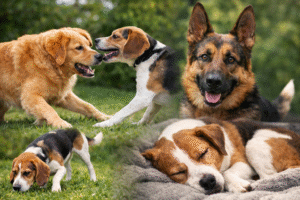
  3. Facial expression-Soft eyes, relaxed mouth with gentle blinking of facial muscles suggest the dog is calm and enjoying. Showing teeth during play may look alarming, but usually harmless if with loose body posture.
  4. Barking-Dog barks usually when it sees strangers or sudden, sharp noises,during sudden excitement,for seeking attention.

Excessive barking may indicate that the dog is in need of exercise, stimulation or companionship.

post image-3

7-Agonistic behavior

  1. Social Hierarchy among dogs– Play fighting among the newborn puppies develops a social hierarchy among themselves, which usually lasts for many years to come. When a strange dog is introduced into a closed social group, usually the group attacks and rejects the stranger. The degree of social hierarchy is much stronger among the same group members. So they react more severely to a stranger dog of the same breed than to other breeds. A similar social hierarchy is also developed with human and normally human is dominant.
  2. Territorial defence– Territorial defence is an important form of social behaviour. Dogs living in a group are usually too protective of their territory and become aggressive when their territory is encroached upon by a strange dog or human. Marking their territory with their urine is also a normal phenomenon in dogs.
  3. Such aggressive behaviour may be avoided by rearing the pup under submission, with the owner being actively dominant. Pups should be socialised with a wide variety of human and canine neighbours.
  4. Tying up a dog usually increases aggression, and the tendency of a dog to fight on the leash is due to such territorial defensive behaviour.

Every dog is unique. Breed, age, environment, and past experiences shape behaviour. What is normal for one dog may look different for another.

To encourage healthy, normal behaviour:

  • Provide daily exercise
  • Offer mental stimulation
  • Maintain routines
  • Use gentle training methods.
  • Show patience and kindness.

Dogs thrive when they feel safe, loved, and understood

      Normal behaviour in dogs is a beautiful combination of instinct, emotion, and learning. Barking, chewing, playing, sniffing, and seeking companionship are not problems—they are natural expressions of a dog’s nature. When owners understand these behaviours, they can respond with compassion rather than correction.

A humane approach to dog care means seeing the world from a dog’s perspective. By respecting their needs and communicating with kindness, we create happier dogs and stronger human-canine relationships.

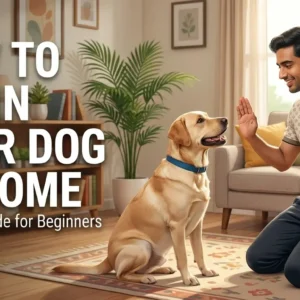
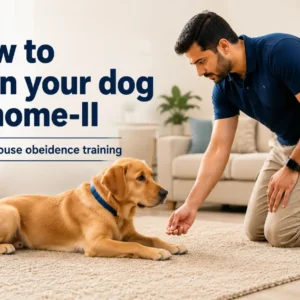
How-to-train-your-dog-at-home

How to Train Your Dog at Home: Basic to Advanced Complete Step-by-Step Guide

The joy of parenting a well-behaved pet is, though not similar, not less than being the father of a disciplined child and training a dog is very much similar to that of a child. Just like humans, the inborn or acquired destructive, harmful and irritating habits of a dog periodically require corrective discipline to improve upon. Without training, a dog may become a nuisance for the family members and visitors. Whether you’ve adopted an energetic puppy or welcomed an older rescue dog, proper training is essential for building a strong relationship and ensuring your pet grows into a well-mannered companion

abnormal dog behavior

Abnormal Behaviour in Dogs and how to correct it

Abnormal Behaviour in Dogs and how to correct it

Abnormal Behaviour in Dogs and how to correct it

Abnormal Behaviour in Dogs and how to correct it

Abnormal Behaviour in Dogs and how to correct it

abnormal dog behavior

            Dogs communicate their feelings and needs through behaviour. However, sometimes dogs may show unusual or abnormal behaviours that confuse or worry their owners. When a dog shows actions that seem unusual, disruptive, or distressing, it’s often labelled as *abnormal behaviour. These behaviours can include excessive barking, aggression, destructive chewing, anxiety, or obsessive habits.

          This guide explains the common abnormal behaviors in dogs and how to correct them effectively, helping owners raise well-behaved and happy pets.

Table of Contents

What is Abnormal Behaviour in Dogs


        Abnormal behaviour refers to actions that are excessive, repetitive, harmful, or out of context for a dog’s age, breed, and environment. Examples include sudden aggression, constant barking, destructive chewing, self-injury, extreme fear, or withdrawal. While every dog has a unique personality, behaviours that cause distress, damage property, or threaten safety are considered abnormal.

           It is necessary to stop these bad habits before established. Later on, when habits become a nuisance, it becomes very difficult to change these habits. Identifying these behaviours early helps owners take corrective steps before the problem worsens.


Common factors responsible for Abnormal Dog Behaviour

Pet owners should consider the following factors to establish the cause of the abnormality.

  1. Poor or late Socialization

     Dogs that are not exposed to people or other animals early in life may become fearful or aggressive towards strangers, children or other animals

.2. Lack of Exercise

     Dogs with too much pent-up energy may develop destructive habits

  1. Stress or Anxiety

     Traumatic experience causing a conditioned emotional reaction is frequently seen in the normally reared dog. For example, a second visit to the veterinary clinics may result in hyperthermia, fright, fight and fear reactions. Changes in the environment, loud noises, or loneliness can trigger abnormal behaviour.

  1. Medical Problems

Pain, illness, or neurological issues may lead to sudden behavioural changes.

  1. Lack of Training

Dogs that do not receive proper guidance may develop unwanted habits.

.  

Types of Abnormal Dog Behaviour with Solution

Extreme aggression towards strangers

       Extreme aggression may arise due to traumatic experiences during the critical period of socialisation or social isolation during this period. When the

        A pup is taken as a pet and lives a fairly isolated life in an apartment (in cities),

Socialisation with other dogs and people is greatly reduced, resulting in extreme aggression towards strangers or other dogs.

      Solution- Gentle handling and re-socialisation will be helpful a lot in such a situation. In extreme cases, sedative drugs may be given in consultation with a veterinarian.

Abnormal care-seeking behaviour


When the dog becomes a child substitute of the family and overprotects it, it becomes dominant and overprotective towards the owner and aggressive towards strangers.

Solution- The dog should not be over-patted, and any undesirable activities must be stopped by a sharp command like.No. Follow the basic rule of training- Undesirable activities must be followed by a sharp NO, and when the dog obeys your instruction, reward it.

Biting and Destructive Chewing

        Chewing is normal for puppies, but when dogs destroy furniture, shoes, slippers, etc., it should be stopped at the start; they will soon become established and difficult to correct, and then your dog may destroy your valuable household items. It may indicate boredom or anxiety. This is particularly seen in puppies when tooth eruption starts, and adult dogs usually chew inanimate objects out of separation anxiety.

Solution-

         Allow puppies to have things like (non-splintering long bones, synthetic bone, rubber-dolls,rubber-balls, etc.) which they can chew on and can identify as their own. If you allow a bone, ensure that it is a suitable one. Act very promptly when the wrong things are being chewed, such as furniture, doormats, slippers, shoes, etc.

Excessive Barking

  Barking in dogs is a natural activity, for it serves as a means of communication, particularly of expressing warning and serves to express pleasure. Barking

serves to tell you when you have visitors, but it should stop as soon as they are identified as friends.

      Excessive barking may be due to poor training, leaving the dog alone for a long period frequently, lack of proper exercise, failed to relieve natural calls.


     Solutions- Controlling barking in old dogs is difficult because old dogs cannot alter their habit of barking, but it is necessary to do something about the excessive noise from your dog. To avoid the situation, providing adequate training and opportunities to get bored should be kept as few as possible.

       You can suddenly start a louder noise when the dog starts his unwanted barking, and in this way, you can make an effort to control the barking in adult dogs.

Chasing motor vehicles

          When you take your dog on a lead near public roads for exercise, many dogs start chasing nearby passing scooters/motorcycles and bicycles, which is not only irritating but also dangerous and may lead to a serious accident.

Solution

        Never allow your dog to chase. Motor vehicles and the practice of chasing must be stopped soon after it develops. Try to exercise your dog in an area away from public roads or roads with minimal traffic. If it is difficult to keep a dog away from traffic, then a lesson to stop this habit is necessary. Allow your dog to chase a car in a safe place, but instead of appearing to be chased away, stop the car and lay down empty cans from the car. In extreme cases, you may have to repeat the lesson several times.

Jumping up on people

        Many dogs jump up on their owner whenever they enter the house, especially after a long gap, returning from a trip. from office etc.afterGenerally jumping up is a delightful expression of devotion by dogs, and is less appealing if you get muddy paws on your clothes or those of others. This habit should never be allowed to start.

Solution

        Always give a strong NO command every time your dog tries to jump up on you or anybody. Gradually your dog will understand that it is a bad manner and may refrain from such activities. You can also overbalance your dog with a well-placed nudge with the knee, and it may take some time to stop this habit.

Begging for food near the dining table

     When family members are taking food to the dining table, dogs frequently beg at the table, which is an undesirable habit. Such a dog always expects food when other family members are eating. The dog which develops this habit gives the impression that he never gets any food, by seeing his anxious look towards the table when you and your friends are taking a meal.

Solution

  1. Separate your own meals from those of your dog.
  2. If possible, feed the dog first so that you do not provoke his appetite with the sight and smell of your own food.
  3. Keep him out of the room where you are having your meal.

Pulling on the lead

      Dogs habitually pull when they are on the lead. Many large-breed dogs get very excited when they know they will shortly be taken for a walk.

Solution

  1. This habit can be cured by the use of a check chain. The dog must be trained to walk to heel. Whenever it pulls forward or backwards, give a short, sharp jerk and then release with the command “Heel”.

        If possible, give a quick run in the lawn, off the lead, which helps to overcome the excitement

Stealing food

          Some dogs cannot resist stealing food if left alone where lots of tempting food is visible. Such a habit should be treated as unacceptable. Dogs also develop a habit of taking food from strangers once they are given free access to take food wherever they like, no matter from which he is getting food.

Solution

  1. Take a cake or other food item most liked by your dog and mix it with any substance which is filled with an unpleasant taste but harmless, such as a teaspoon of mustard powder and put it on the table as bait.
  2. Give the command “Leave” and then go out of the room for a moment. If the dog has not touched the bait, praise it upon your return, but if it has been eaten, it will have sufficient punishment. Some dogs swallow titbits so fast that they might not taste the mustard. In such cases, you should offer larger baits that need to be chewed.
  3. Repeat this procedure until your dog is convinced that all stolen foods have an unpleasant taste.

Frequently Asked Questions

What is the most common abnormal behaviour in dogs?

Excessive barking, aggression, and destructive chewing are the most common behavioural problems

Yes. With proper training, exercise, and patience, most behavioural issues can be improved.

Sudden aggression may be caused by fear, stress, pain, or environmental changes.

   It depends on the severity of the issue and the consistency of training. Some improvements may appear within weeks.

     No. Punishment can increase fear and aggression. Positive reinforcement works better.

Conclusion

       Understanding abnormal dog behaviour is essential for every responsible pet owner. Behavioural problems such as excessive barking, aggression, separation anxiety, or destructive chewing often stem from underlying causes like stress, lack of training, or health issues.

         With patience, consistency, and the right approach, most abnormal behaviours in dogs can be corrected. A well-trained and emotionally healthy dog not only leads a happier life but also builds a stronger bond with its owner.

featured-1

Understanding Your Dog’s Behavior

Understanding Your Dog's Behaviour

           Someone rang your doorbell, and your dog starts barking. It continues to bark till you stop that by a sharp command. Let’s understand why your dog behaved in that way. Understanding the natural behaviour is helpful in handling your dog, providing better care and building a stronger relationship with your dog. It is also important to a pet parent in the sense that any unusual or changed behaviours may indicate the possibility of an underlying illness or disease.

Dogs’ natural behaviour has emerged after their long association with humans from the prehistoric age, and in modern times as a furry friend. During this evolutionary process, their behavioural chemistry is shaped by a beautiful blend of species-specific instincts, acquired knowledge, learning, and emotion.

Let’s see some normal behaviour of dogs.

1-Feeding behaviour

  1. Suckling-Soon after birth, pups suckle milk from the mother, which increases after the third day. Taking food from the mother starts at about 3 weeks of age. Pups usually take food from their mother’s bowl or may eat vomitus of the mother, which should not be considered abnormal. Pup may take food material from the bowl and eat by keeping it in another place.
  2. Chewing and licking-Pups generally chew licks to investigate small objects and may ingest them, which must be prevented to avoid any health hazards. Adult dogs also chew to release boredom,and also to clean their teeth. Instead of scolding and preventing the dog from chewing dog should be provided with safe toys or objects.

2-Sexual behavior

  • Sexual behaviour starts after the onset of puberty. There is a great level of individual and breed variation regarding the onset of puberty. Sexual behaviour like mounting, clasping and pelvic thrust are seen at the age of puberty more in male but active courtship occurs only when the female is in heat. Olfaction, or the sense of smell, is the main receptor governing the onset of sexual behaviour. The urine of bitch in estrus is the first triggering point for an active courtship to happen.
  • Spaying or neutering a bitch at any age makes it unresponsive sexually. While castration done only before puberty makes a male non-responsive.
  • Male dogs prefer sexual activity better if familiar with the surroundings and the handler. So, bitch must be taken to the dog for an intercourse to happen. Many times, when the male is not dominant during courtship, the female frequently mounts the dog and stimulates the aggressive behaviour of the dog.
  • When both male and female are reared together, and the female is dominant in the social hierarchy, mating is usually rare.

3-Maternal behaviour

  1. Nest making behaviour– Towards the onset of parturition bitch usually make nest to give birth its puppies. Following parturition bitch starts nursing the young and usually stays with the puppies for 3 weeks. Later contact with the pup decreases. This is the time for weaning.
  2. Cleaning behaviour– Bitch usually stimulate urination and defecation in the pups by licking the anogenital region of the pups. During nursing, the bitch ingests the urine and faces of the pups and keeps the nest clean in the 4th week; such cleaning behaviour disappears when pups begin to leave the nest for elimination independently by their own.
  3. Pseudo pregnancy– Due to hormonal imbalance, even though the dog is not pregnant dog displays maternal protective behaviour like nest making, engorgement of mammary gland, protecting an inanimate object placed in the nest, etc. Such a condition should be treated by a qualified vet.

4- Social behaviour

      By nature, dogs are social animals and live in groups in a pack. With a long association with members of one pack, they develop a high degree of communication, cooperation and bonding, which is essential for their survival. In a pack, they usually follow the instructions of the leader. So, dogs leave happily with their boss. With the adoption of a dog as a family member, they usually see the family as a pack and try to please the members and accept the head of the family as their boss. Some positive social behaviours are

  1. Seeking attention and companionship from family members.
  2. Wagging tail and following the owners around the house.
  3. Enjoying playing with humans and other dogs.
  4. Leaning against family members.
  5. Licking the face or hand of family members to show affection.
  6. Learning by watching human closely, exploring new objects.
  7. Following command of family members and trying to please them

5-Eliminative behavior

  1. Raising of the hind legs prior to urination– Raising of the hind legs prior to urination in male dogs is an inherent activity in male dogs. It occurs after the onset of puberty.
  2. Covering of faces by pawing-Immediately after defecation, dogs usually paw and want to cover their faces. It may be due to its natural instinct acquired during wildlife by which it destroys the evidence of faces that might attract the wild predator and attack it.

6-Commiunicative behavior

Dogs usually communicate with the external world  through body carriage, vocal sounds, tail posture,submassive paw raising, and urination. Learning and interpreting these signals is crucial to know dogs mental state and behaviour. Some of the behaviours are

  1. Position of the tail  Wagging of the tail frequently occurs during excitement and happiness. A relaxed, slow wagging is an expression of happiness, whereas a stiff, high tail indicates alertness and tension.
  2. Position of ears– Relaxed ears suggest comfort. Ears kept forward suggest enthusiasm or curiosity. Contracted, backward ears suggest fear or submission.
  3. Facial expression-Soft eyes, relaxed mouth with gentle blinking of facial muscles suggest the dog is calm and enjoying. Showing teeth during play may look alarming, but usually harmless if with loose body posture.
  4. Barking-Dog barks usually when it sees strangers or sudden, sharp noises,during sudden excitement,for seeking attention.

Excessive barking may indicate that the dog is in need of exercise, stimulation or companionship.

post image-3

7-Agonistic behavior

  1. Social Hierarchy among dogs– Play fighting among the newborn puppies develops a social hierarchy among themselves, which usually lasts for many years to come. When a strange dog is introduced into a closed social group, usually the group attacks and rejects the stranger. The degree of social hierarchy is much stronger among the same group members. So they react more severely to a stranger dog of the same breed than to other breeds. A similar social hierarchy is also developed with human and normally human is dominant.
  2. Territorial defence– Territorial defence is an important form of social behaviour. Dogs living in a group are usually too protective of their territory and become aggressive when their territory is encroached upon by a strange dog or human. Marking their territory with their urine is also a normal phenomenon in dogs.
  3. Such aggressive behaviour may be avoided by rearing the pup under submission, with the owner being actively dominant. Pups should be socialised with a wide variety of human and canine neighbours.
  4. Tying up a dog usually increases aggression, and the tendency of a dog to fight on the leash is due to such territorial defensive behaviour.

Every dog is unique. Breed, age, environment, and past experiences shape behaviour. What is normal for one dog may look different for another.

To encourage healthy, normal behaviour:

  • Provide daily exercise
  • Offer mental stimulation
  • Maintain routines
  • Use gentle training methods.
  • Show patience and kindness.

Dogs thrive when they feel safe, loved, and understood

      Normal behaviour in dogs is a beautiful combination of instinct, emotion, and learning. Barking, chewing, playing, sniffing, and seeking companionship are not problems—they are natural expressions of a dog’s nature. When owners understand these behaviours, they can respond with compassion rather than correction.

A humane approach to dog care means seeing the world from a dog’s perspective. By respecting their needs and communicating with kindness, we create happier dogs and stronger human-canine relationships.