How to train your dog at home-II: In-house obedience training
How to Train Your Dog at Home-II: In-house obedience training
-
Dr JM Panda Dr Jatindra M Panda
We have covered basic house training of your dog in the first part of the article, which includes manners training also. If you have not gone through it, please read it first at the link mentioned at the bottom of this article and then read this post. In this article, we will cover in-house obedience training, which consists of a series of useful commands that help you control your dog in day-to-day situations and further strengthen your bond with your dog. Your dog will slowly learn to act upon your command and always be ready to please you.
Table of Contents
Lessons of Stay-sit-down
During day-to-day situations, you may require your dog to stand, sit or down. These positions are essential and helpful to manage your dog in daily life in your house.
Sit position- Ideal for short-term control.
Down position- When you are required to be free to carry out some other function and may be out of the dog’s sight.
Stay or stand position- This is required when you want your dog to stop during movement or stand when it is in another position
Stay command
- Create a situation when the dog wants to meet a family member who is at a distance. The dog should be on a lead and ahead of you when allowed to meet the family member.
- Instruct to stay and accompany this with tension on the lead to halt him. After 10 to 15 seconds, release the tension. Any attempt from the dog to move forward must be stopped by a resumption of lead tension and the repeated instruction to stay.
- Continue to ease off the lead tension and repeat the instruction until your dog is prepared to stay.
- Give some gentle praise.
- When the dog is prepared to stop and stand when instructed without any tension on the lead, then carry out a similar routine exercise while off the lead. When the dog is 3 to 4 metres away and moving, give prompt instruction to stay, keep him there, go to him and give him praise, then release him from the position.
- Practice the exercise with him during more stressful situations.
After you have suitably covered the stay command, then teach the lesson of the sit command.
Sit command
How to Train Your Dog at Home-II: In-house obedience training
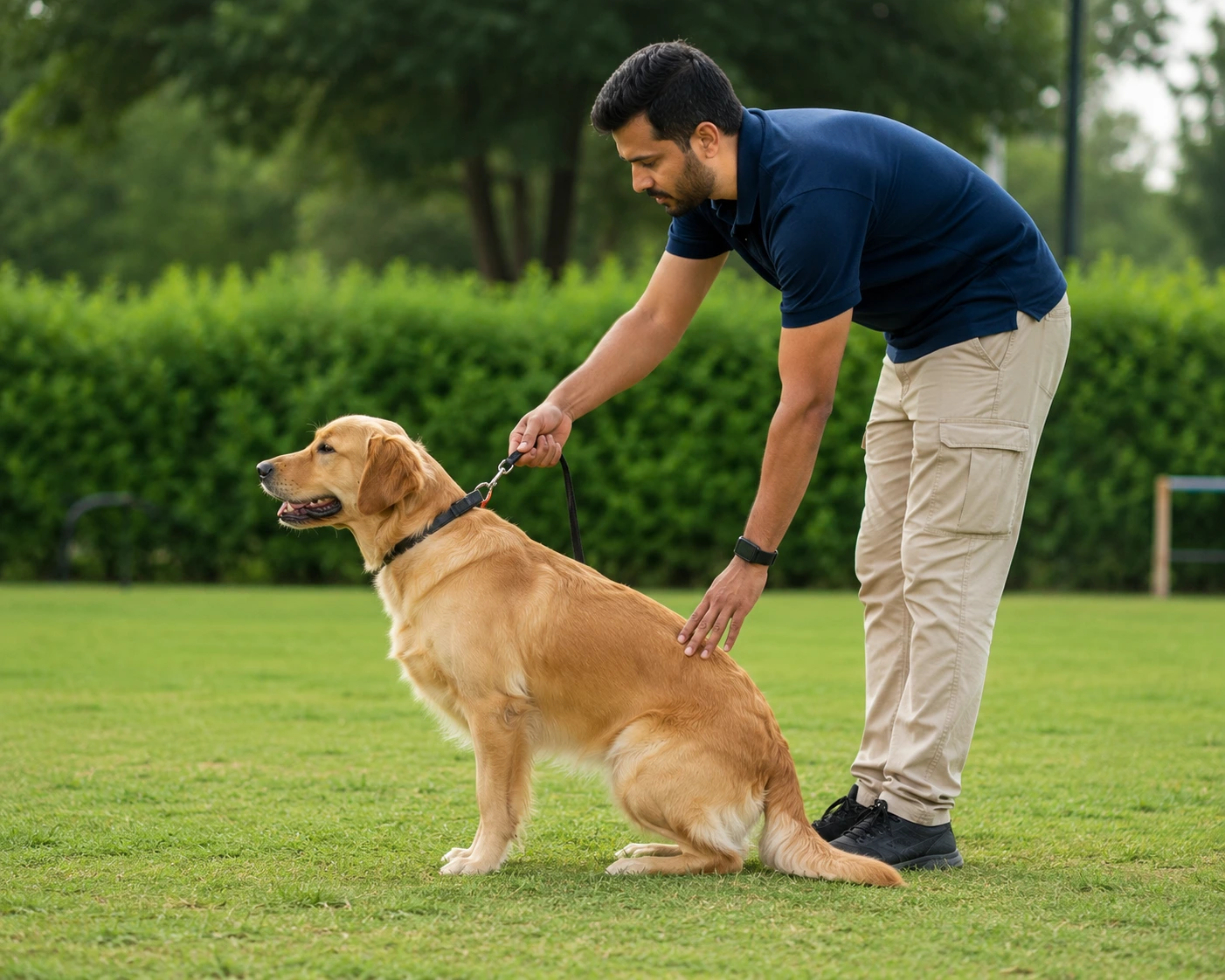
- Make sure your dog is with the lead and collar. Position yourself on the right side of your dog.
- Stand parallel to your dog. Take a very short grip on the lead with the right hand as near to the collar as possible. At the same time, put your left hand at the left side of your dog’s croup.
- Push his rear end down and towards you as your right hand pulls upon the lead. This double action must be properly coordinated. As you start to carry out this double action, use a gentle voice of encouragement, but as soon as he starts moving into the sit, give a firm ‘sit’ instruction.
- Keep your dog in that position for 5 seconds. On completion of the action, give your dog praise but ensure that he does not attempt to move.
- Your dog will soon anticipate and start moving into the sit position as soon as you go into the routine of taking the lead in the right hand and putting your left hand by the croup.
- After a few days of training, walk around your dog, but still holding the lead and continuing with the instruction to stay in the sit position. Gradually build upon distance and time in the stay position, initially with the lead but later on without lead.
Once your dog has completely picked up the sit command, then start teaching the down command.
Down command
- Have your dog sitting at your left side and put yourself into a kneeling position.
- Put your left arm over the dog’s shoulder so that your left hand is positioned behind his left pastern. While doing this, put your right hand behind his right pastern.
- Push his front feet forward so that he will drop into his chest. At the same time, let your own body weight drop so that you can rest with your left elbow on the ground.
- When your dog anticipates your action and starts to move into the down position, give the instruction to go down with emphasis on the ‘down’. Watch your dog for any attempt to get up. Keep your dog in that position for a few seconds and give gentle praise.
- After a few sessions of training, soon your dog will understand the meaning of the ‘down stay’ instruction.
- After sufficient progress has been made, move a little distance from him and repeat the command. Gradually build upon the distance and the time that you are away from your dog.
Stand-sit- stay command should be alternately and repeatedly practiced over a few days to have a long-lasting impression upon the dog’s brain.
To come back when called
This training must be done just before feeding time or when you are about to take your dog for a walk to take maximum advantage of your dog’s natural response to everyday situations. At feeding times, when he hears his food is ready, or when it is the time for a walk, the picking up of his lead is enough to let him know he is going out.
- A moment before you make your intentions known to your dog, call his name and add the instruction to ‘come’. The noise of his feeding dish or the picking up of the lead will create the response and thereby give meaning to the instruction come. Practice this for 4 to 5 days before moving to step 2.
- Take your dog outside with a choke collar and a line of suitable length (about 25 feet long). Let the dog stroll away from you within the limits of your line.
- Attract his attention by calling his name. When the dog’s attention is drawn towards you, give the command ‘come’ or ‘here’. If he is reluctant to come, gently pull him, but do not drag him. When he has come to you, pat him, reward him and again let him stroll away.
- Repeat the process several times till he starts coming without being pulled by the line. When the dog becomes completely obedient on a long line, set him free and let him stroll away, and when he is fairly far away, repeat the lesson as taught already.
- During positive response, the dog should be rewarded by words of praise and a gentle but appreciative stroke of hand. A dog will usually come back to his owner when there is no good reason for staying away.
Then why does your dog not respond to your call? Here is the reason
An interesting smell
- A bitch in estrus
- A playful canine companion.
- Fear of his owner.
- Greater distance between dog and owner
A combination of any two factors, along with the strength of a distraction, can be a powerful factor leading to defiance of your dog.
Shake hands
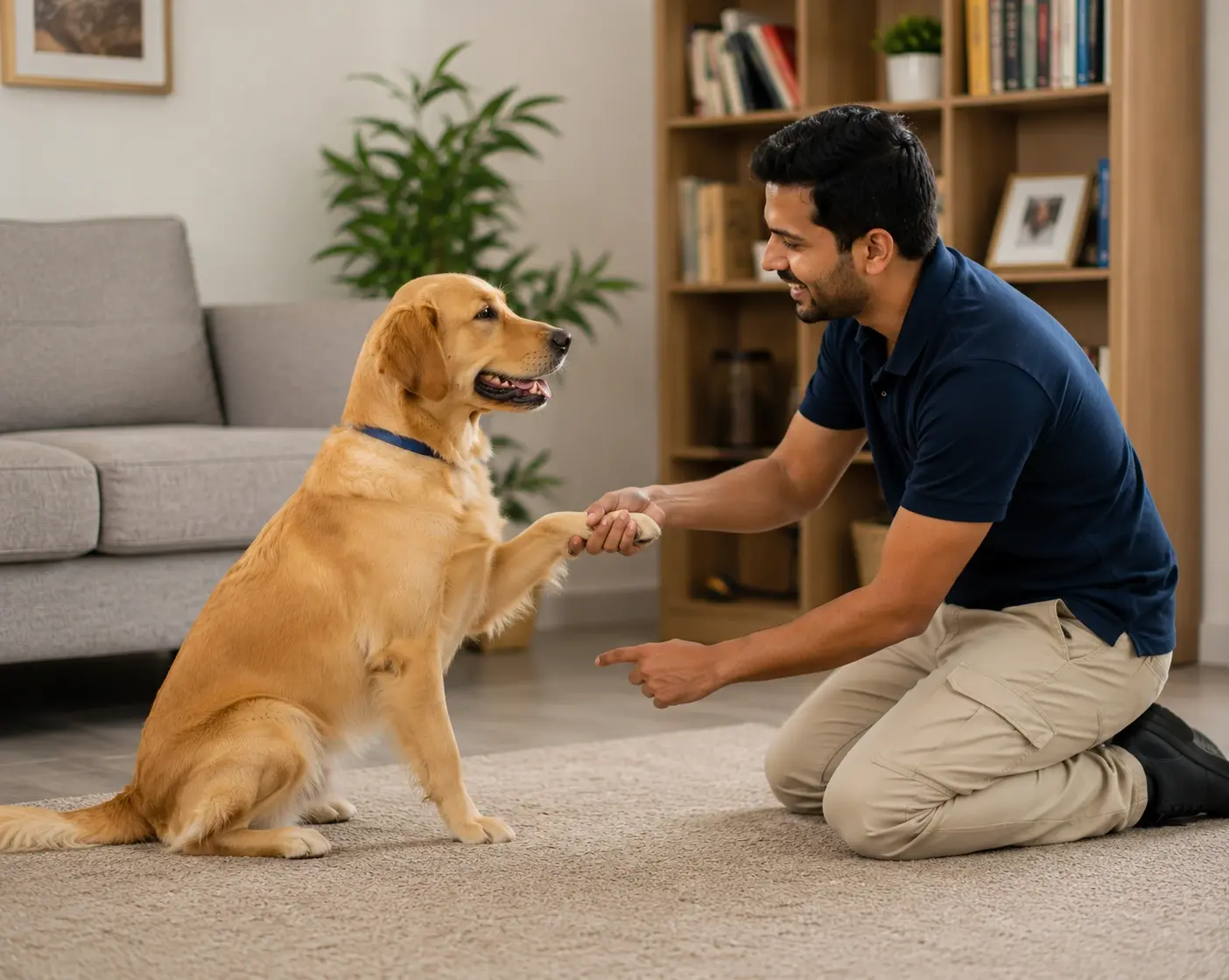
It is a dignified method to express his affection to his owner, instead of jumping over or licking him. Follow the following steps.
- Command your dog to sit. Sit with your dog in a face-to-face position.
- Gently tickle the side of his elbow and give the command ‘shake hands’. When the dog raises his paw, as he is bound to do, take it in your hand, shake it gently, and put it down.
- Try to make him shake his paw simply by speaking out the command, stretching out one hand, and tickling with the other hand the leg you wish him to raise.
- In the next stage, he should obey on verbal command and by your holding only one hand out in anticipation of shaking hands.
- By repeating this exercise for a few days, the dog usually holds out his paw for you to shake purely on verbal command.
- At this point, you can easily teach him to shake hands with either the right or left paw by adding ‘right’ or ‘left’ to ‘shake hands’.
To fetch article (Retriever)
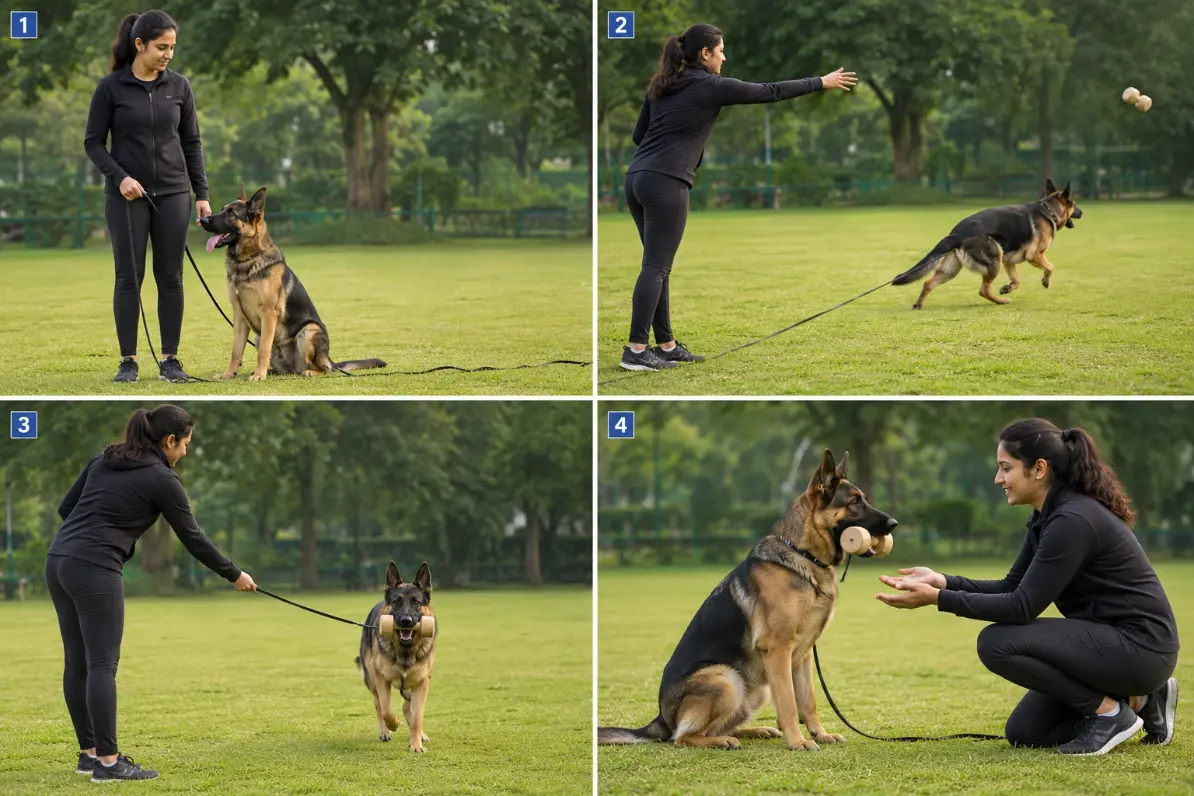
- Start the training with your dog having on a long line or cord and sitting at your left-hand side.
- Throw a suitable article, either a proper training dumbbell or ball, and give the command ‘fetch’ in an encouraging manner. The dog should run and pick up the article.
- Once this has occurred, gently pull the line and give the command ‘come’. When the dog responds, ask it to sit in front of you and praise it for holding the article well.
- Take the article in both hands, give a command such as ‘drop’ and gently remove the article from the dog’s jaws. Pat and praise sufficiently.
- Repeat the sessions many times till it becomes a habit for the dog.
Opening and Shutting of Doors
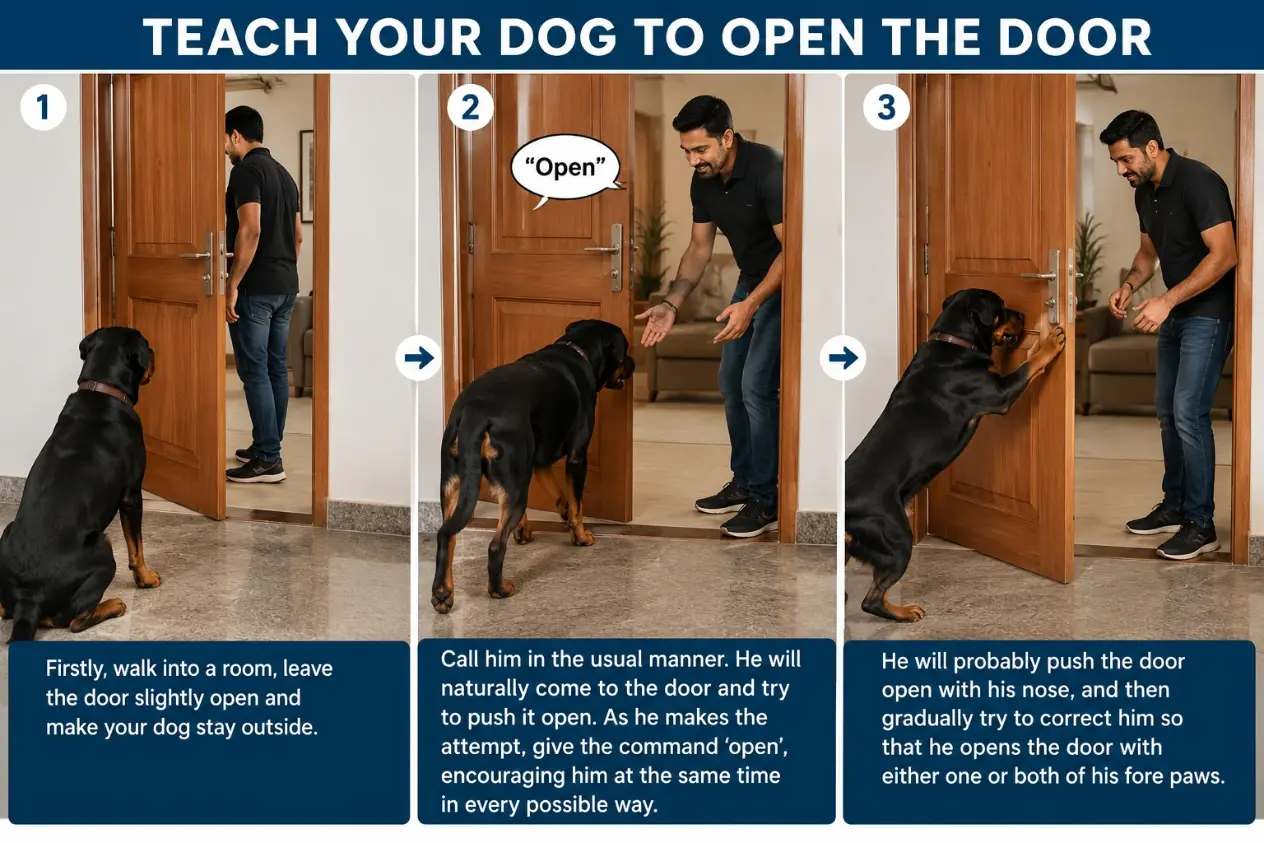
To teach your dog to open and shut the door may prove useful to you. Follow the steps
- Firstly, walk into a room, leave the door slightly open and make your dog stay outside.
- Call him in the usual manner. He will naturally come to the door and try to push it open. As he attempts, give the command, ‘open’, encouraging him at the same time in every possible way.
- He will probably push the door open with his nose, and then gradually try to correct him so that he opens the door with either one or both of his fore paws.
- To teach a dog to open doors from the outside, follow a similar procedure, but this time leaving the dog inside the room and calling him from outside with the door slightly open. He will again probably begin by placing his nose in the crack and squeezing himself through, but again encourage him to use his paw rather than his snout.
- To teach shutting the door, take your dog near to an open door. Place one hand on the top of the door, and encourage him with the other by placing it against the door, to put one or both of his front paws on the door as you give the command ‘close’. A dog that has learnt to shake hands will probably learn to do this in no time.
Final Tips for Successful In-House Obedience Training
- Be patient and stay positive.
- Train every day, even if only for 10 minutes.
- Use rewards your dog enjoys.
- Keep commands short and consistent.
- Celebrate small improvements.
- Build trust before expecting perfection.
Frequently Asked Questions
How long does it take to train a dog at home?
Most dogs begin learning basic commands within a few weeks of consistent daily training. Complete obedience training may take several months, depending on the dog’s age, breed, and personality.
What is the best age to start training a puppy?
You can begin basic training and socialization as early as 8 weeks of age. Early training helps establish good habits and prevents unwanted behaviors.
Can older dogs still be trained?
Yes. Older dogs can learn new commands and behaviors successfully. While they may take a little longer to adapt, consistent positive reinforcement works well at any age.
How many times should I train my dog each day?
Two to three short sessions of 10–15 minutes each day are generally more effective than one long session.
Should I use treats every time?
Treats are very helpful during the learning phase. As your dog becomes more reliable, gradually replace treats with praise, toys, or affection while continuing to reward good behaviour occasionally.
Why isn't my dog listening?
Common reasons include inconsistent commands, distractions, lack of motivation, or training sessions that are too long. Keep sessions short, use high-value rewards, and practice in a quiet environment before increasing distractions
Is punishment an effective training method?
Modern dog training experts recommend positive reinforcement over punishment. Rewarding desired behaviors builds trust, strengthens your bond, and encourages your dog to repeat good habits.
.
Can I train my dog without hiring a professional trainer?
Yes. Most pet owners can successfully teach basic obedience, house training, and good manners at home using consistency, patience, and positive reinforcement. Professional help is mainly needed for complex behavioural issues.
Conclusion
Remember that every dog learns at its own pace. Some may master a new command in a few days, while others need a little more time. Stay consistent, keep training sessions enjoyable, and celebrate every milestone along the way.
In the next article, we will cover some more important commands for outdoor obedience training, like street behaviour, automobile training, etc which you can read here.
Also Read