How to Train Your Dog at Home: Basic to Advanced Complete Step-by-Step Guide
How to Train Your Dog at Home: Basic to Advanced Complete Step-by-Step Guide
How to Train Your Dog at Home: Basic to Advanced Complete Step-by-Step Guide
How to Train Your Dog at Home: Basic to Advanced Complete Step-by-Step Guide
-
Dr JM Panda Dr Jatindra M Panda
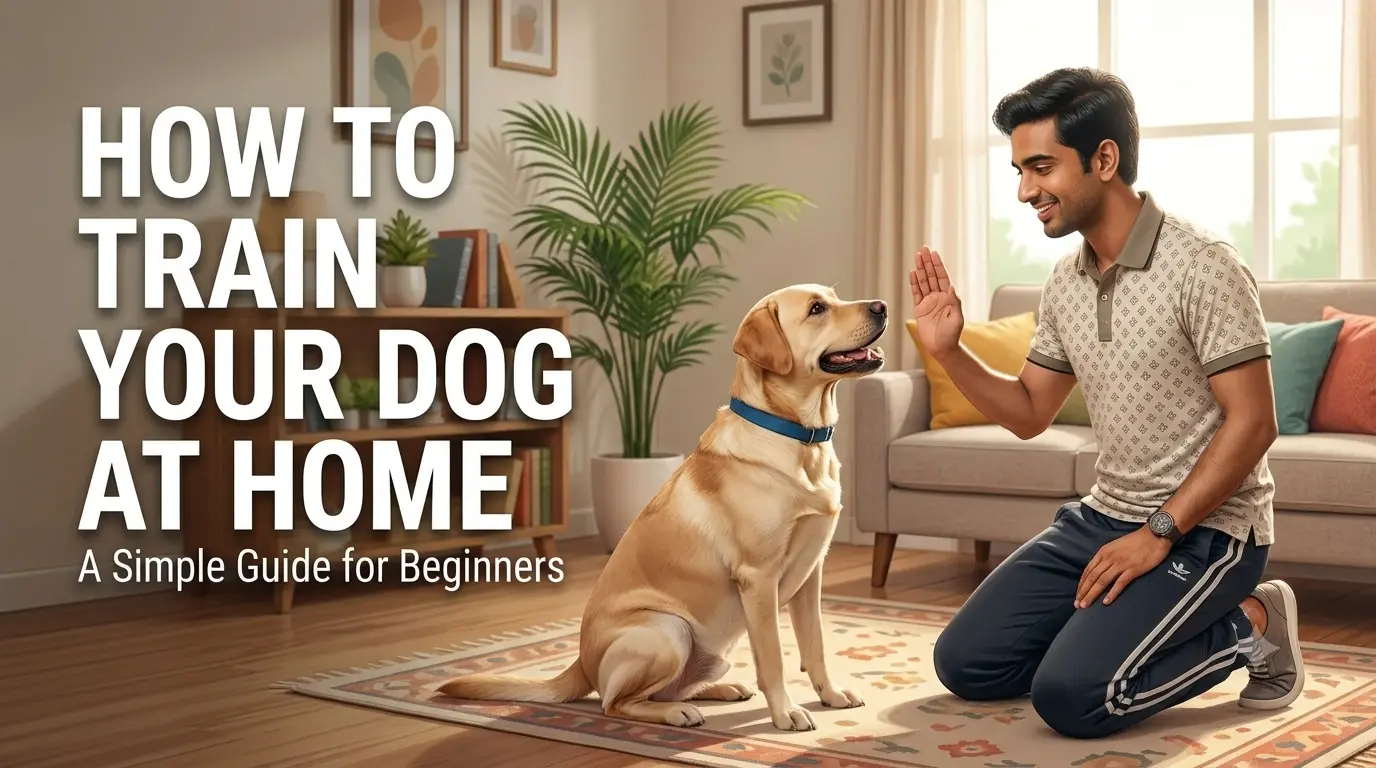
The joy of parenting a well-behaved pet is, though not similar, not less than being the father of a disciplined child and training a dog is very much similar to that of a child. Just like humans, the inborn or acquired destructive, harmful and irritating habits of a dog periodically require corrective discipline to improve upon. Without training, a dog may become a nuisance for the family members and visitors. Whether you’ve adopted an energetic puppy or welcomed an older rescue dog, proper training is essential for building a strong relationship and ensuring your pet grows into a well-mannered companion.
The good news is that you don’t need expensive professional training to teach your dog basic manners and obedience. With consistency, patience, and the right techniques, you can successfully train your dog at home.
In this journey, we will learn everything about training—from preparing for training sessions to teaching essential commands and correcting unwanted behaviours using positive reinforcement.
Table of Contents
Why it is necessary to train a dog
Every dog should be trained in basic obedience. Without training, the dog becomes refractory and a nuisance to visitors as well as to the owner himself. Training is much more than teaching your dog to sit or shake hands. Proper early training inculcates good habits which become deep-rooted as years pass and strengthens the bond between the family members, dog and society. Proper training
- Creates trust, improves communication, and prevents behavioral issues that may become difficult to manage later.
- Understands household rules and always follow to please his master.
- Build confidence and improve social behavior.
- Makes the dog acceptable to all. Everybody likes a well-behaved dog.
- Makes the dog happier, more relaxed, and easier to manage during daily activities.
How does a dog learn?
- Learning through conditioning– Dogs learn through associations and consequences. They connect actions to outcomes. If a behaviour earns a reward like treats or praise, they do it again and again. You say “Sit,” the dog sits, and you instantly give a treat. The dog learns that sitting earns a reward.
- Learning through linking: Dogs learn to link unrelated things through repetition. The sight of a food bowl means dinner. They learn to feel excited before the actual fun begins.
- Learning through contextual connection- Dogs are contextual learners. They take “mental snapshots” of a room. If you teach a dog to “Sit” in the quiet living room, they might not know what “Sit” means in a busy park. Their brains see the park as a completely new picture.
- Learning through watching others– Puppies and older dogs learn by watching other dogs or humans. Example: A puppy learns to walk upstairs by simply following an older dog that is already doing it.
Stages of dog training
|
Type of training |
Learning commands |
Age to start |
|
Basic house training |
· Potty training · Name recognition · No command · To Wear Collar and Lead · Not to Jump up when Expressing Affection) · Table manner |
After 2 months |
|
Obedience training |
· Lessons of Stay · To Come Back When Called · Shake Paws (hand) · Street behaviour |
After 3 months |
|
· Training for automobile · Opening and Shutting of Doors · To Jump Obstacles · To Fetch Article · Sit-up on Haunches Sit-up is a most · Not Pick-up Food Lying on Ground · Not Accepting Food from Stranger
|
After 6 months |
|
|
Advanced training |
· Tracking object/path of criminal · Detecting explosive · Attacking on command · Guarding premises/properties · Assisting individual with disabilities |
After one year |
A pause,
There is a vast list of commands that can be learned by a dog. The goal of training a dog should not be to teach every command to your dog. Depending on your dog breed, utility training of your dog can be customised. If we go through all the commands of all the stages, this article will not justify the objective. So in this article we will cover the basic house training, and in the next article, we will cover the obedience training. Advanced training is beyond the scope of the book as it is neither necessary for a family pet nor required too. However, if sufficient comments are received from readers, we can cover it in a separate dedicated article.
The golden principles of dog training
- Training should be done by one person only. Never train your dog with all family members.
- Always train your dog when you are in leisure, free and not in a hurry.
- Train your dog when he is calm and happy. If a dog is scared, stressed, or too excited, their brain struggles to learn.
- Always keep training sessions short, fun, and successful. 10 to 20 minutes of training two to three times a day is sufficient to train a dog.
- During training, when your dog gets it right, appreciate sufficiently by stroking, patting and a general show of being pleased with his performance. Repeat the same commands every time.
- Rewards in the form of food or handling are good reinforcing stimuli and should be used when your dog catches things right. Always reward your dog within a few seconds after it performs the desired task. Timing is critical. If you wait too long, your dog won’t understand what earned the reward.
- Consistency is the secret to successful dog training.
Before starting training
- Get your pup socialised after it attends the age of 6 weeks with the family and other human beings, animals, different sounds, various surfaces (grass, concrete, sand), car rides, parks, and pet-friendly places.
- Socialisation is most stable during the period of 6 weeks to 8 weeks. After this critical period of socialisation, approach behaviour toward human beings is reduced, and avoidance behaviour is marked.
- Before beginning, make sure you have the right mindset and equipment.
- Train your dog before meals when he is motivated.
Essential Training Supplies
-
You’ll need:
- Small training treats.
- A comfortable collar or harness.
- A standard leash.
- A favourite toy.
- Plenty of patience.
Remember, your attitude directly affects your dog’s willingness to learn
Basic dog training
Potty training
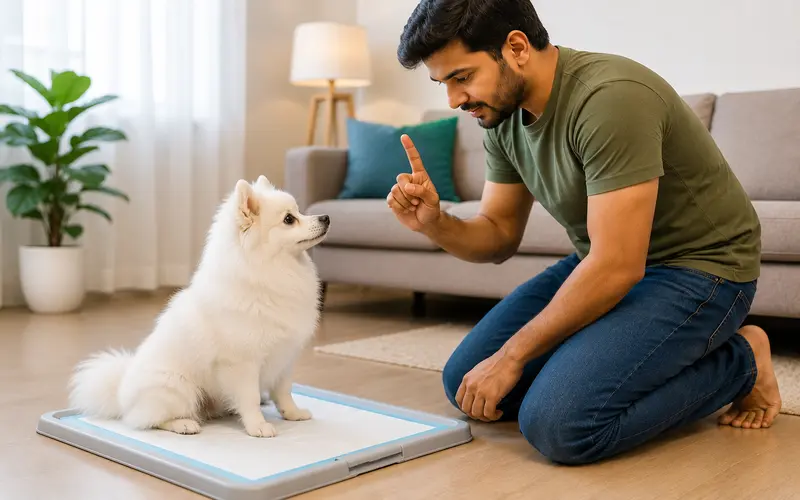
- Follow a set time schedule for the dog’s feeding. Since a puppy usually relieves itself soon after eating, it is highly advisable to maintain the feeding schedule. If this is done, the puppy will soon learn to anticipate feeding times, and his need to relieve himself will automatically become regular.
- Puppies give a clear indication for relieving themselves by feeling anxious or uncomfortable without barking. This is the time to take him outside immediately and stay with him until he relieves himself. Soon you will notice that he will bark at the door whenever he feels the necessity to ease himself. If you do not, he will probably just sit on the doorstep until you let him in again.
- If this practice is followed consistently, he will perform his duty at a proper place. He will soon learn what is expected of him, and soon you will mark that he will bark at the door whenever he feels the necessity to ease himself.
- During the course of training, take the dog each time to the same spot where he has done the duty previously.
- Put a patch of straw in a place you want your dog to perform this duty. At night or when the weather outside is bad, get him to relieve himself on newspaper.
Calling by name
- Keep your dog’s name very short and precise. It should be associated with kindness and affection.
- The same name must be used clearly by all family members every time to call him. Otherwise, the dog will be confused and may not respond.
- After calling your dog by name, wait until it looks at you. Immediately reward them. Repeat several times daily till your dog consistently looks at you after hearing its name.
- For naming your dog, explore here.
No command
- The first word to learn after the name you give is ‘No’. This means stop whatever you are doing at once. It should be short and direct.
- Speak it firmly and somewhat loudly, but without harshness or aggressiveness.
- Always say NO. Do not use words like ‘Do not do that’ or ‘bad’ or ‘naughty dog’; otherwise your dog will become confused and will not respond to the command word.
To Wear Collar and Lead
-
Most dogs can wear collars from an early age.
-
Put the collar on with a gentle pat and praise when the pup is in a happy mood. Your pup may feel discomfort in the beginning and try to remove the collar from the neck by the action of his legs and by shaking his head. Put it on for a short period at first to keep it distracted.
-
You can start this training just before feeding so that he will think more about food and less about the collar.
-
After a few days, fit a lead in the collar. Do not be engaged with your dog in a tug-of-war. Be strict and never give the impression that he will win the war.
Not to Jump Up when Expressing Affection
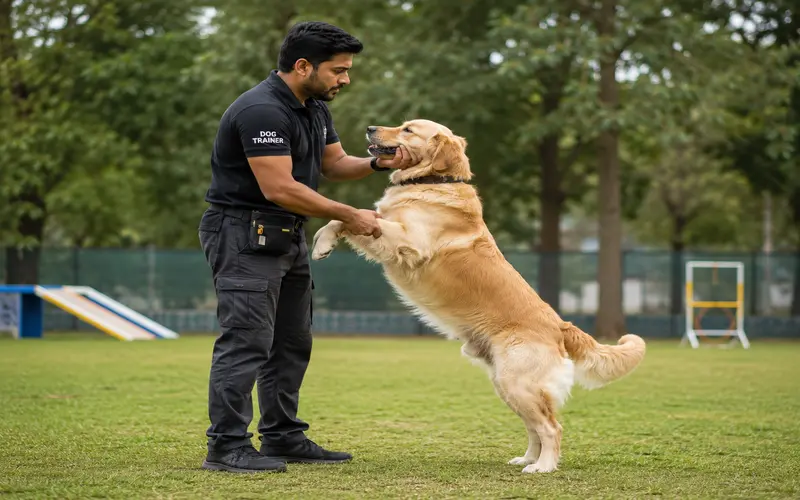
- Dogs express love by licking and jumping over as natural methods of expression. But if it has become your dog’s usual behaviour, it will be necessary to come out with a firm ‘No’ every time it happens. Imagine you came from the office and were invited by your dog with muddy paws on your shirt.
- Discourage the habit of jumping up to people.
- As soon as the dog stands on his hind legs and is about to put his front paws upon you, give support to the dog’s front legs with your left hand. Then, with the palm of the right hand, support the dog’s head by placing your hand under his lower jaw, and gently tickle it with your fingers while speaking to him kindly.
- After a few sessions, refuse to support his front legs and lower jaw. He will drop down instead of putting his front paws on your body.
- Similarly, for licking, also prevent licking by placing your hand under his lower jaw, and gently tickle it with your fingers while speaking to him kindly.
table manner
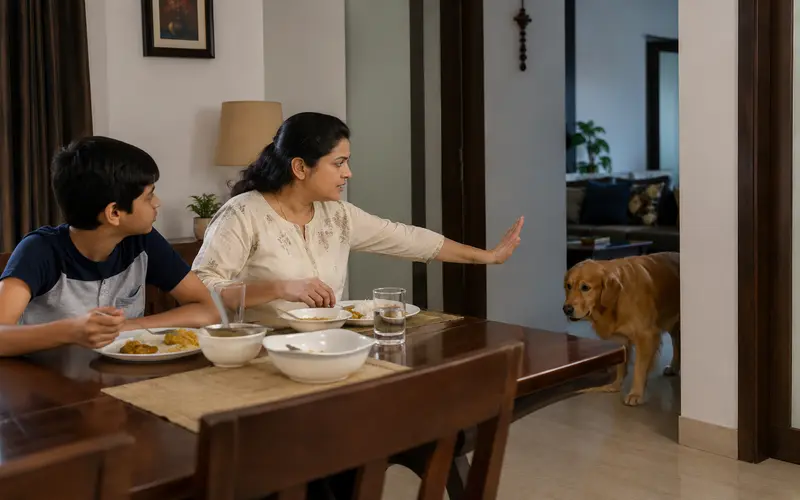
- Never feed dogs from your own table; if you do, you will find the habit difficult to break, and your dog will become a continuous nuisance.
- Feed your dog first, so that you do not provoke his appetite with the sight and smell of your own food.
- Keep him out of the dining room where you are having your meal.
- Never share any food, like snacks, etc with your dog; otherwise he will expect it from you every time he sees you eating.
Tips for correcting offensive act
- Always act immediately whenever you see your dog committing an offensive act. Try to discourage bad habits from the start. Do this with firmness.
- In case the response to your training effort is poor, never lose temper or inflict any cruel punishment.
- Prevention and association with unpleasantness for an offensive act is the best method of making a dog disciplined. For example, if your dog is chewing furniture, shoes, etc., you can command with a firm no and spray some neem oil beforehand, which tastes bitter. Slowly, your dog associates the bitter taste with chewing your shoes and will refrain from doing it again.
- A dog develops a good amount of knowledge of right and wrong by combining pleasant or unpleasant results with his action and always tries to please his master.
Common Dog Training Mistakes to Avoid
- Never start a training session if you are short of time or are feeling tired or tense.
- Never start a training session if your dog is scared, stressed, or too excited.
- Never punish your pup for accidents; praise him when he gets it right, ignore him when he does not.
Frequently Asked Questions
How long does it take to train a dog at home?
Most dogs begin learning basic commands within a few weeks of consistent daily training. Complete obedience training may take several months, depending on the dog’s age, breed, and personality.
What is the best age to start training a puppy?
You can begin basic training and socialization as early as 8 weeks of age. Early training helps establish good habits and prevents unwanted behaviors.
Can older dogs still be trained?
Yes. Older dogs can learn new commands and behaviors successfully. While they may take a little longer to adapt, consistent positive reinforcement works well at any age.
How many times should I train my dog each day?
Two to three short sessions of 10–15 minutes each day are generally more effective than one long session.
Should I use treats every time?
Treats are very helpful during the learning phase. As your dog becomes more reliable, gradually replace treats with praise, toys, or affection while continuing to reward good behaviour occasionally.
Why isn't my dog listening?
Common reasons include inconsistent commands, distractions, lack of motivation, or training sessions that are too long. Keep sessions short, use high-value rewards, and practice in a quiet environment before increasing distractions
Is punishment an effective training method?
Modern dog training experts recommend positive reinforcement over punishment. Rewarding desired behaviors builds trust, strengthens your bond, and encourages your dog to repeat good habits.
.
Can I train my dog without hiring a professional trainer?
Yes. Most pet owners can successfully teach basic obedience, house training, and good manners at home using consistency, patience, and positive reinforcement. Professional help is mainly needed for complex behavioural issues.
Conclusion
Training is a lifelong process. As your dog grows and learns, continue reinforcing good habits through regular practice.This is all about basic house training. We will learn about obedience training in our next article, which you can read here.
Share your Dogs training stories here. If you have any query, please feel free to post it here.