

Deworming Your Dog: Killing the Gut Worms
Deworming Your Dog: Killing the Gut Worms
Deworming Your Dog: Killing the Gut Worms
Apart from providing nutritious food, regular exercise, and routine vaccinations, something more important is required to keep your dog healthy. That important aspect is deworming your dog regularly. During my practice, many times I felt that as long as a dog eats and defecates normally, the owner never bothers about its health. But many diseases enter the dog’s body so silently that till significant damage is caused, the dog seldom shows any symptoms. Worm infestation is such a common infection that it is easily overlooked by pet parents.
Most of the worms are common parasites that live inside a dog’s digestive system and feed on nutrients from its body, causing digestive problems, weight loss, anaemia, and poor growth. Some worms can invade other organs like the liver, lungs, heart, blood vessels, etc and cause serious health complications. Puppies are particularly vulnerable because their developing immune systems may not be strong enough to fight these parasites.
The good news is that most intestinal worm infections can be prevented and treated with appropriate veterinary medicines. This article covers everything you need to know about dog deworming, including types of worms, symptoms, schedules, treatment, and prevention tips.
Table of Contents
What is deworming
Deworming in dogs is the process of giving anthelmintic drugs that kill or remove parasitic worms and eggs from a dog’s body. These medicines target specific worms and either kill them or help the dog’s body eliminate them through faeces.
Deworming is not simply a treatment for dogs that already show symptoms. It is also an important preventive healthcare measure because some infected dogs may appear perfectly healthy while carrying intestinal parasites.
Importance of deworming
Regular deworming plays an important role in maintaining your dog’s overall health.
- Improves digestive health: Intestinal worms can interfere with nutrient absorption and damage the digestive tract. Proper deworming helps to improve digestion and nutrient absorption.
- Supports healthy growth: Puppies need adequate nutrients for proper development. Heavy worm infestations can affect their growth adversely. Deworming encourages healthy growth in puppies.
- Protects your family: Certain dog parasites, including roundworms and hookworms, can infect humans. Maintaining hygiene and proper deworming helps reduce this risk.
- Supports long-term health: Preventing repeated infections helps maintain your dog’s nutrition, energy, and vitality.

Common types of worms and parasites in dogs
Sl No | Name of the worm | Site of infestation | Harms caused by worms | Remarks |
1 | Roundworms | Live in the intestines | · Swollen belly, · vomiting, · diarrhoea, · poor growth | Puppies are most affected. |
2 | Hookworms | Attach themselves to the intestinal wall and feed on blood | · anaemia, · weakness, · pale gums · bloody stools | Puppies are at an increased risk of infection. |
3 | Tapeworms | Live in the small intestine. | · Usually do not cause any serious issues | Segments of parasites may be seen around the anus or in faeces. |
3 | Whipworms | Live in the large intestine | · Diarrhoea · weight loss · inflammation | Causes irritation and swelling of the anal region. Reinfection is common |
4 | Heartworms | Live in the heart, lungs, and even blood vessels | · Exercise intolerance · Coughing · Poor growth | If left untreated, they can cause severe complications like lung disease or heart failure in dogs. |
5 | Giardia | Single-celled protozoa. Attach to the intestinal lining. | · Dehydration · Diarrhoea · Weakness | Cannot be seen in faeces |
Apart from these, worms can also affect the lungs, liver and brain.
How does your dog get a worm infestation?
- Dogs during their outdoor activities may eat, lick, or sniff worm eggs or larvae found in polluted soil, grass, or faeces contaminated with infective stages of worms.
- By eating infected rodents or other small animals carrying larvae
- By entering through the skin of paws when walking or other parts during sleeping or wandering in infected areas.
- From the infected mother that transmits the worms to the puppies (trans placental transmission)
- When it comes into contact with contaminated household environments through shoes, bedding, or surfaces carrying eggs or larvae
Symptoms of Worms in Dogs
Common symptoms include:
- White discharge from both eyes
- Diarrhoea or loose stools.
- Vomiting, sometimes containing worms.
- Weight loss despite a normal appetite.
- Swollen or pot-bellied appearance.
- Dull coat and poor body condition.
- Scooting or excessive licking around the anus.
- Visible worm segments in faeces.
- Weakness and pale gums, particularly with hookworms
More severe symptom
- Weak pulse
- Breathing difficulty
- Pale gums
- Dark urine
Many dogs look apparently healthy, still harbouring parasites. A laboratory examination of stool can identify the types of worms and can be treated accordingly.
Deworming schedule
Deworming schedule for puppies
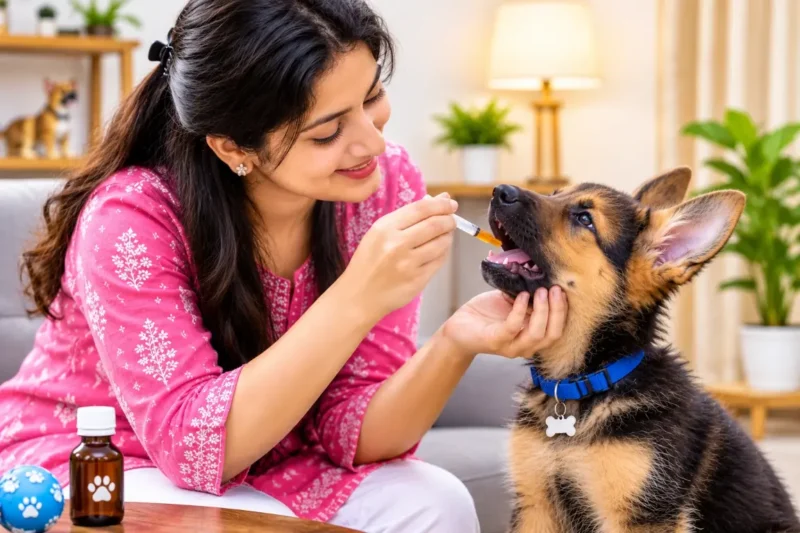
- Young pups may be dewormed as early as 15 days. The best drug in this case is Pyrantel Pamoate available in suspension for human use. It can be given 1 ml per kg of the dog’s body weight.
- If your dog is weak or under any stressful condition, reduce the dose to half, i.e. 0.5 ml per kg body weight.
- Repeat the medicine as per the body weight at an interval of 14 days until the pup becomes 3 months old.
- It is good practice to deworm your pup one day before the date of vaccinations, as multiple doses of vaccination are to be done up to 3 months.
- After 3 months, deworming can be done every one or one and a half months till the pup attains the age of 6 months.
Deworming schedule for adult dogs
- After 6 months, deworm your dog with the prescribed deworming medicine and repeat the same medicine after 21 days to complete one set of deworming.
- Repeat the set of deworming every 4 months in normal dogs.
- It is advisable to change the medicine from the previous one to rule out the development of resistance.
- However, if you notice any symptoms of worm overload, deworming can be done immediately after consulting your vet.
- Dogs that spend considerable time outdoors, hunt, eat raw meat, or have frequent flea exposure may face greater parasite risks. In such cases, examination of a faecal sample every 3 months and deworming the dog with an appropriate dewormer lowers the risk significantly.
Common drugs used for deworming
Sl No | Age of dog | Salts | Forms of salts | Doases |
1 | 15 days to 3 months | Pyrantel pamoate Pyrantel with febantel | Suspension | 1 ml per kg body weight |
2 | 4 to 6 months | Pyrantel with praziquantel and febantel or fenbendazole | Tab/suspension | 1 ml/kg body wt 1 tablet/10 kg body wt |
3 | 6 months and above | Praziquantel with Ivermectin | Tablet | 1 Tablet for 10 kg body weight |
5 | 3 months and above | Selamectin | Spot on | As per the product leaflet |
6 | 2 months and above | Fenbendazole | Suspension | As per the product leaflet |
**Consult your veterinarian before giving higher salt.
Alternate methods of deworming
Homoeopathic medicine
- It is a safe and non-chemical method of deworming, particularly in adult dogs.
- The best homoeopathic drug is Cina. 30 potencies of this drug can be given.5 drops may be given in the morning and evening to large and medium-sized dogs, and 2 drops twice daily can be given to small-sized dogs continuously for a period of 5 to 7 days
- Though it acts slowly and results may be seen after 10 days or more, it builds internal immunity in dogs to fight against the parasites.
- Never use in young puppies.
Natural way of deworming
- Apple cider vinegar, which is easily available in fruit jam, jelly, etc., is the best agent for natural deworming
- 5ml of the solution diluted in 15 ml of water for large-sized dogs, and 2 ml of the solution diluted with 6 ml of water once daily, given for 3 days, eradicates most of the gut worms.
- It changes the gut PH making the gut environment unsuitable for survival of the parasite thereby eliminated from the body.
- Food containing high fibre, like banana, apple, pumpkin, etc also helps in reducing worm loads in dogs.
Note: This information provided is only for educational purposes and should not replace expert veterinary advice. Deworming schedules might vary depending on a dog’s age, breed, health, environment, and parasite risk. Always contact a certified veterinarian before beginning or changing your pet’s deworming routine, as intestinal parasitic infections might sometimes need medications along with deworming.
Side effect of dog deworming
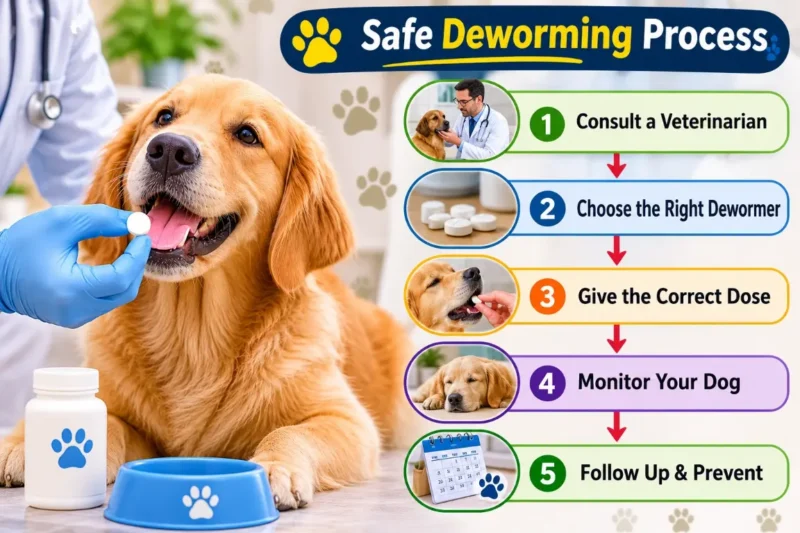
While deworming medications are generally safe, some dogs may develop mild side effects.
- Vomiting: Some dogs may vomit shortly after taking the medication. If they vomit within 30 minutes, consult a veterinarian; they might suggest a re-dose.
- Diarrhoea: This is the most common one. It might take 24-48 hours to resolve completely.
- Worms in the stool: Dead worms may be visible in the faeces after treatment, which is completely normal and expected.
- Reduced Appetite: This can occur in some and may last a day or two, then resolves.
- Lethargy: Some dogs may seem tired or less active than normal for a day or two as their body responds to the treatment.
Note: If the side effects do not resolve within the timeframe specified by your veterinarian, consult them promptly to prevent potential complications.
Important tips for getting the best result of deworming
- Whenever you go for deworming, always repeat the same dose 21 days from the date of initial deworming. These 2 deworming treatments complete one set. The reason behind this is that during the first deworming, eggs and larvae of the parasite get escaped from the effect of dewormer as most of the deworming medicines kills the adult worms only. By 21 days these eggs hatches and larvae grown in to adult thereby killed by the deworming agent.
- Schedule regular veterinary examinations at least at every 3 months interval.
- To avoid tapeworm infections, use flea prevention medications.
- Keep your dog’s dwelling place clean and disinfected on a regular basis.
- Clean up dog faeces right away to avoid reinfection.
- Provide clean, fresh food and water every day.
Common mistakes to avoid while deworming
- Never go for deworming with higher salt. Your dog requires deworming every 3 to 4 months. Using higher salts for routine deworming for a long time may make the drug ineffective. Once resistance develops, lower salts may not work properly, and deworming will become ineffective.
- Always stick to the basic single salts like albendazole, fenbendazole, piperazine, etc. But if the parasite load is heavy and evident on laboratory examination of stool, higher salt or deworming medicines containing a combination of salts must be given to get rid of the worm load. It must be done under the supervision of your vet.
- Not following a regular deworming plan as recommended by the veterinarian.
- Following advice from friends, relatives, or social media rather than a qualified veterinarian
Frequently Asked Questions
Can deworming medicine be given to pregnant dogs?
It is always advisable to deworm your dog before pregnancy, particularly during the heat period. If it is required to deworm the dog during pregnancy, it can be done with specific medicines. Fenbendazole is the best dewormer and is safe during pregnancy. Consult your vet before deworming pregnant dogs.
Can homoeopathic medicine be used for deworming of dogs?
Yes, but it requires multiple doses of medicine administered over a period of a week. It shows results slowly after 10 days of administration. But I never recommend homoeopathic medicine in puppies. Always go for allopathic medicine to deworm the puppies.
Does resistance develop in the worms against a deworming medicine if given repeatedly?
It is very rare in dogs. However, rotating the deworming medicines is advisable for getting the best results after deworming.
My dog starts developing loose motion and vomiting after deworming; what can I do?
It occurs if your dog is too weak or under any stress. Reduce the dose to half. Give plenty of fluids, antidiarrheal medicine and probiotics in consultation with your vet. Normally, if the worm load is high, dogs develop loose stools and get cured automatically when the worms are expelled from the gut. Similarly, in puppies, drugs containing mabentel causes paralysis of worms and gastric irritation and diarrhoea
Is it necessary to give liver tonic at the time of deworming?
Usually, dewormers used during routine deworming do not cause harm to the liver or kidneys. However, you can give liver tonic 3 days before and 4 days after giving deworming medicines if you are overly conscious about your pet’s health. But it is a good idea to give probiotics after deworming to minimise gastric upset.
Does a puppy get worm infestation from its mother?
Yes, a pregnant bitch can transmit infective stages of worms to their puppies.
Can humans get worm infection from dogs?
Yes, some intestinal worms, such as hookworms and tapeworms, can spread from dogs to humans by contact with contaminated soil, faeces, or fleas. Good hygiene and regular deworming of pets significantly lower this danger.
.
Can I deworm my dog at home?
Should I deworm a healthy-looking dog?
Yes, a pregnant bitch can transmit infective stages of worms to their puppies.
Conclusion
Deworming your dog is an essential part of responsible pet ownership. Intestinal parasites can silently affect your dog’s digestive health, nutrition, growth, and overall quality of life. You can keep your dog healthy, comfortable, and protected from harmful worms throughout its life by adhering to an appropriate deworming plan, practising proper hygiene, and getting veterinary assistance as needed.
If you have any query related to the topic or any other pet related issues please feel free to post your comment below
Also read
Vaccination Schedule in Dog: A complete Dog Vaccination Guide (2026)


One Response
This article is well written any cleared many of my doubts related to deworming in dogs.